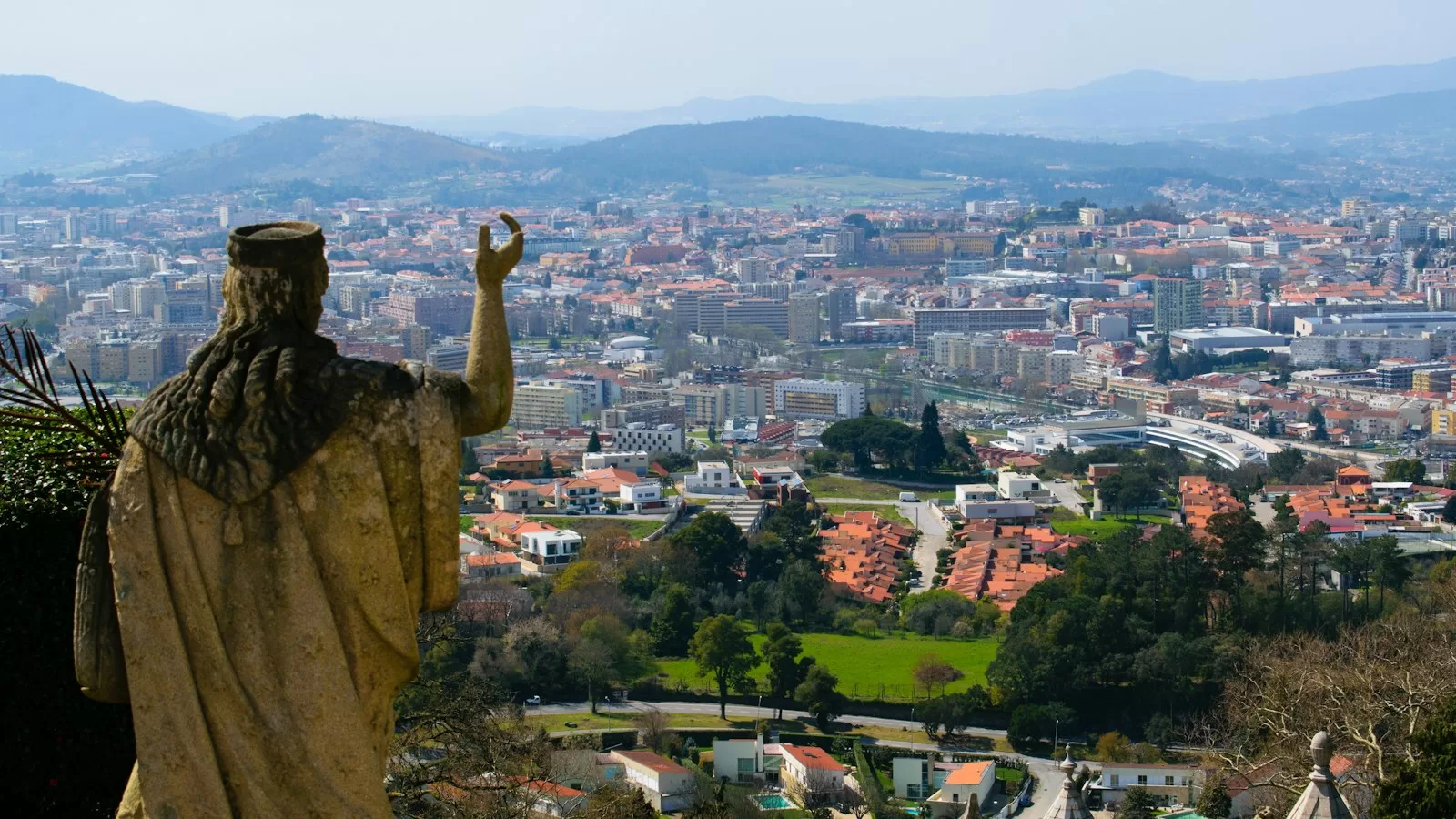
In Braga, the customer who doesn't know you yet is the one searching hardest
Some businesses in Braga have never needed a website. The restaurant has filled up with the same regulars for twenty years, the clinic runs on referrals, and everyone who walks down the street knows the shop on the corner.
That model still works with the people who were already here. The trouble is that official figures from Statistics Portugal show Braga growing on the back of someone else: people who arrived recently, have no neighbour to ask, and make every decision on their phone.
For them, your website and your Google listing are not an extra. They are the first impression, and often the only one.
Braga is growing, but not through births
The 2021 census counted 193,324 residents in the municipality. Statistics Portugal's estimate for 2024 is 203,519. That is more than ten thousand extra people in three years.
The figure that changes the picture is a different one. In 2024, 1,581 people were born in Braga and 1,473 died. Natural growth was 0.1%. Total growth, which includes people moving in and out, was 1.0%. Almost all of the increase comes from outside.
Who are the newcomers? Some come from abroad. According to the 2024 migration report from AIMA, Portugal's immigration agency, 28,538 foreign nationals lived in the municipality in 2024, roughly one in seven residents. Braga is one of the twelve municipalities with the most foreign residents in the country, and the only one outside the Lisbon area, Porto and the Algarve.
The University of Minho, with campuses in Braga and nearby Guimarães, had 20,544 degree students at the end of 2024, of whom 2,271 held a foreign nationality. Every year a new wave arrives that has no idea where to find a good dentist or a reliable mechanic.
It is also a young city by Portuguese standards. Braga's ageing index is 153.4, against 192.4 for the country as a whole.
Someone who arrived two years ago has nobody to ask. They have a search bar.
And visitors make up their minds in under two days
Tourism adds another layer. In 2024, Braga's hotels and guesthouses welcomed 372,878 guests and recorded 678,666 overnight stays. The average stay was 1.8 nights, below the national average of 2.5. Foreign guests made up 42.1%.
Someone staying a night and a half does not research restaurants the week before. They search on the day, in the street, on their phone, and pick whatever comes up first and looks trustworthy.
In 2025, when Braga was Portuguese Capital of Culture, the organisers counted more than 1.5 million attendees across 1,155 events. Not all of them were visitors, and the figure does not say how many came from elsewhere, but it shows the scale of the movement.
Add to this the pace of new businesses. In the twelve months from November 2024 to October 2025, 1,008 new companies and similar legal entities were registered in the municipality. That is fresh competition every week.
The tension that decides what goes on your website
The typical Braga business sells from the inside out, on its reputation among people who already know it. The city is growing from the outside in, with people who don't know anyone yet.
Your website has to do the job word of mouth used to do. In practice that means four things.
Answer people who don't know the city. A street name means everything to a local and nothing to someone who arrived in September. Use landmarks anyone understands: near which well known spot, where to park, which bus stops nearby, whether there is wheelchair access. Put opening hours, an indicative price and how to book on the first page, so nobody has to dig.
Think phone first. Google uses the mobile version of a site to index and rank it, and recommends that the mobile version has the same content as the desktop one. If your menu, price list or contact form only works properly on a computer, then for Google and for the customer in the street it might as well not exist.
Speak the language people search in. An English version makes sense for the four in ten guests who come from abroad and for many international students and professionals. Google recommends a separate address for each language, visible links to switch between versions, and no automatic redirects based on the browser's language. It also warns that translating only the menus and buttons, while the content stays in another language, makes for a poor experience.
There is a detail almost nobody considers. Brazilians are the largest group of foreign residents in Portugal, and Braga is known for a large Brazilian community, although there are no official figures by municipality. They speak Portuguese, but they search with different words: "academia" rather than "ginásio" for a gym, "aluguel" rather than "arrendamento" for a rental, "celular" rather than "telemóvel" for a phone. You don't need another version of the site. You need to use, naturally, the words your customers actually use, in your FAQs and service descriptions.
Be clear about what and where. Google explains that local results depend on three factors: relevance (how well a listing matches the search), distance, and prominence (how well known the business is, reviews included). For a "near me" search, distance is calculated from the searcher's location, and there is no honest way to change that. What you control is the rest: saying in plain text what you do and where, with a page for each important service, and building up genuine reviews. Creating fake pages for neighbourhoods where you have no presence is the shortcut that tends to backfire.
Your website and your Google listing must tell the same story
A newcomer usually sees your Google Business Profile first, then opens your website. If the listing says you close at 7pm and the website says 8pm, they stop trusting both.
Three simple rules:
- The name on the listing is the business's real name. Google's guidelines do not allow unnecessary extras in the name, such as search terms or the neighbourhood, and warn that doing so can get the profile suspended.
- Opening hours, phone number and address are identical in both places, including special hours for holidays and events, which is exactly when most visitors search.
- The listing's link goes to the right page: the menu, the booking form, the list of services. Not a generic home page where the customer has to start over.
What this means for each kind of business
- Restaurant: an up to date menu as text, not a photo of a printed sheet; an English version; kitchen hours; booking in two taps.
- Clinic: specialties explained in everyday language, languages spoken by the team, insurance accepted, booking online or by message.
- Shop: what is in stock and at roughly what price, how to get there, whether you take orders by message.
- Estate agency: median sale prices for homes in Braga rose from €1,552 per square metre in the first quarter of 2024 to €1,808 in the second quarter of 2025, according to Statistics Portugal. Buyers paying that from outside the city want to understand the areas, not just see photos. One page per parish or area you actually cover, in Portuguese and English, is worth more than twenty more listings.
- Services (accountants, garages, repairs): the area you cover, typical lead times, what to bring to the first visit.
The five minute test
Do this this week, ideally with someone who moved to Braga recently:
- On your phone, on mobile data, open your website as if you didn't know the city. In three taps, can you find where you are, when you're open and how to book?
- In the street near your business, search for what you sell followed by "near me", then followed by "in Braga". See who comes up and why.
- Compare your Google listing with your website line by line: name, hours, phone, address.
- Ask someone who doesn't speak Portuguese to use your site. Watch where they give up.
Every point that fails is a new customer who walked into the shop next door.
How Digito helps
We have been based in Braga since 2017 and we see this shift in the city every day. What we do answers the problems in this article:
- A website built for newcomers: we build websites that answer, on the first page and on a phone, the questions of someone who doesn't know the city: where you are, when you open, what it costs, how to book.
- Other language versions done properly: each language with its own address and full content, no menu only translations, no redirects that hide pages from Google.
- Honest local search: pages for each service and for the areas you really cover, in the words your customers use, with no shortcuts that put your listing at risk.
- Website and Google listing in line: we review both side by side and fix the gaps. You can start with our free review of your listing and your website.
- Photography and content: if your menu is still a photo of a sheet of paper, or you lack good images of your space, our team takes care of it.
If you want your business to be found by people who arrived in Braga yesterday, get in touch.
Sources
- Statistics Portugal (INE), 2021 Census, resident population by place of residence (final results, Braga: 193,324)
- Statistics Portugal, municipal feedback report for Braga, December 2025 (2024 population estimates, births and deaths, total and natural growth, ageing index, 2024 tourism, new legal entities, housing prices, gross value added)
- AIMA, Migration and Asylum Report 2024 (foreign residents by municipality; Brazilian nationality as the largest group)
- Migration Observatory, Foreign resident population in Portugal (2024), January 2026
- University of Minho, Activity Report and Accounts 2024
- Observador, Braga 25 closing figures, 28 December 2025
- DN Brasil, interview with the Mayor of Braga, 27 August 2026
- Google, Tips to improve your local ranking on Google
- Google, Guidelines for representing your business on Google
- Google Search Central, Managing multi-regional and multilingual sites
- Google Search Central, Mobile-first indexing best practices