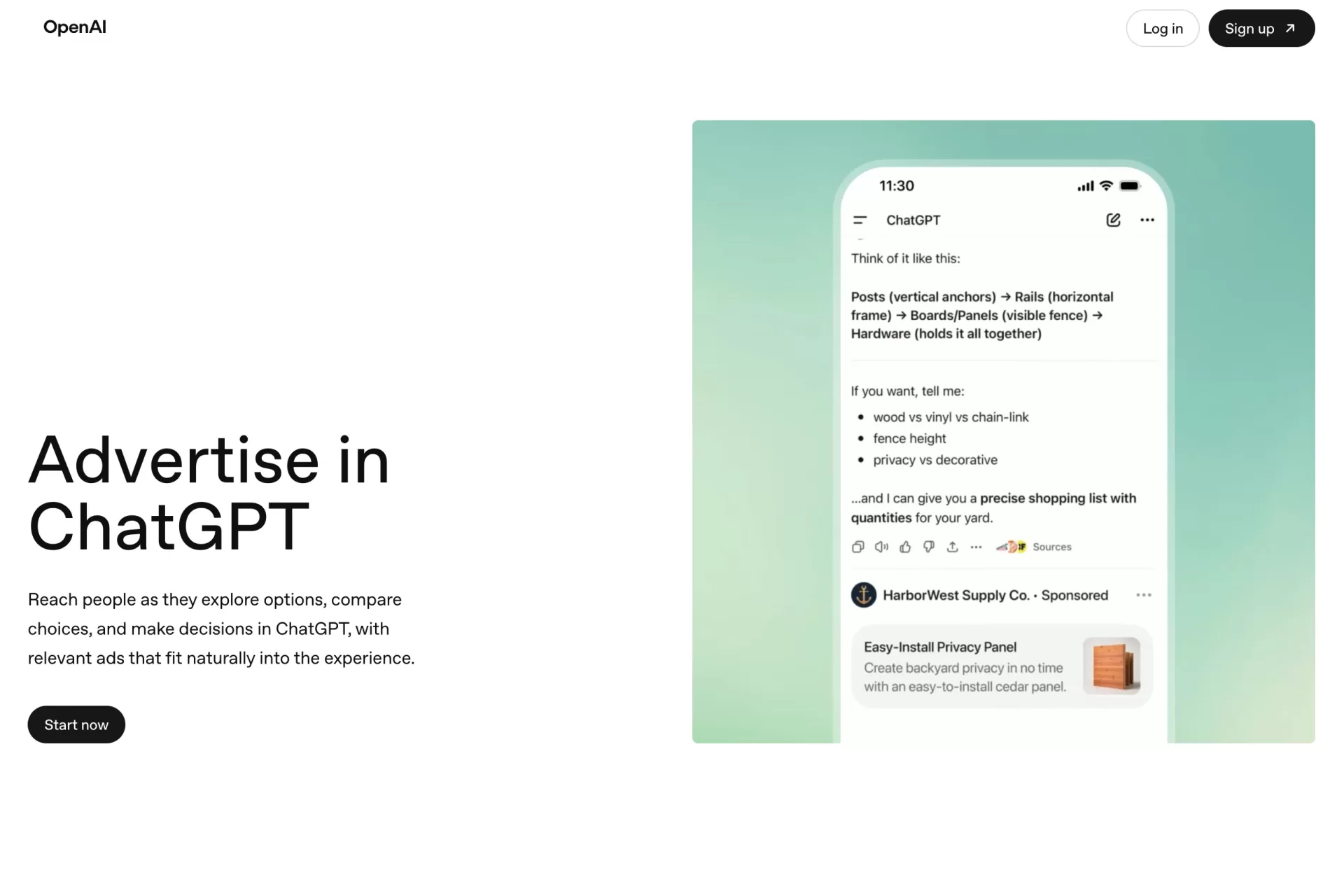
For years, the question any advertising platform had to answer was "how many people clicked the ad?". Then the market matured and the question became "how many bought?", and then "what did each sale cost?". We are now entering a more demanding phase, where the question is starting to be "did those people buy because of the ad, or would they have bought anyway?". It is a small difference in the sentence and a huge one for whoever pays for the campaign.
Three weeks ago we explained, in the next ad does not open a website, it opens a conversation, how advertising is moving from the click to the conversation. On 5 October OpenAI answered the next question, the one that matters to anyone deciding budgets: how do you measure whether that conversation sold?
What OpenAI announced on 5 October
The visible part of the announcement is a new format: visual advertising during image generation in ChatGPT. Someone asks "help me imagine a minimalist living room with a beige sofa, a wooden table and warm lighting" and, while the system works on that intent, a related ad may appear. According to OpenAI, the ads are clearly labelled and kept separate from the generated image, and advertising does not influence ChatGPT's answers. Testing begins later in October, in the United States, with an initial group of advertisers and with users on the Free and Go plans.
A caveat for anyone reading from outside the US: this does not mean you can open an account tomorrow and run a campaign like this in your market. Not yet. And the format is not even the most important part of the announcement.
The part that matters to whoever pays is measurement
A platform can have millions of people and an interesting format, but if a business cannot tell whether the ads generate business, there is a ceiling on the budget it will put there. Google and Meta learned this many years ago, which is why an invisible infrastructure sits behind every campaign: pixels, events, conversion APIs, UTMs, CRM connections, attribution, experiments, audiences and first-party data.
OpenAI is building its version of that infrastructure. It announced integrations with Hightouch, Tealium and LiveRamp so that companies can send conversion data from the systems they already use, and support for web and app attribution partners including AppsFlyer, Triple Whale, Adjust, DV Rockerbox, Northbeam, Branch, Singular, Kochava, Airbridge and Tenjin. It looks like a list for specialists. It is, in fact, the answer to the question that decides whether a platform gets a five-hundred-euro experiment or an annual budget: "can I prove this sells?".
A click is easy to measure, a conversation is not
In a traditional campaign the sequence is simple: ad, click, website, purchase. Now imagine a conversation. The person asks which is the best chair for working eight hours a day, then whether it suits someone who is 1.90 m tall, then whether it comes in black. They see an ad, carry on the conversation, do not buy. Two days later they search the brand on Google, visit the site and, a week later, buy directly. Which channel sold? Google, ChatGPT, direct, the brand, all of them?
A purchase rarely happens in two steps, especially when the product is expensive or requires comparison. Someone buying a three-thousand-euro electric bike may watch a Reel, ask ChatGPT, compare models, watch a YouTube video, read reviews, visit the shop, receive remarketing, search the brand and buy three weeks later. Attributing the sale to the last click is pretending the earlier steps never happened.
Conversation can make this problem bigger, because it influences the decision without immediately generating a visit. The user discovers, asks, compares, eliminates alternatives and gets very close to the decision before setting foot on the brand's website. Measuring only the traffic sent can understate the platform's impact, in the same way Google today gets credit for demand a video created.
Attribution and incrementality are not the same thing
This distinction should be part of the training of any company that invests seriously in marketing. Attribution asks "which channel gets credit for this sale?". Incrementality asks "would this sale have happened if we had not run the campaign?". The second question is much harder and much more valuable.
Imagine a thousand people bought and the platform attributes two hundred sales to the campaign. Looks excellent. But if a hundred and seventy of them would have bought anyway, the real impact was thirty. Or imagine a shop with a hundred thousand euros in monthly sales that launches a campaign and does a hundred and ten thousand the following month. The platform says it generated fifteen thousand in revenue. Maybe the shop would have grown naturally to a hundred and seven, maybe there was an email campaign, maybe it was peak season, maybe the ads created only three thousand euros of extra sales. Without a test, you do not know.
This is where OpenAI's least flashy and most important announcement comes in: it is working with Haus, Measured and WorkMagic on geo-based experiments to measure the causal impact of campaigns. The company itself says this work is at an early stage, and that should be taken literally. But the direction is right, for a reason that applies to any platform: whoever sells advertising and measures advertising has an obvious conflict when it announces that its advertising worked. That does not make the numbers wrong. It makes it unwise to decide where to invest based on a single source, which is why the entry of external measurers matters.
The first results, read with care
OpenAI presented some partner-reported results. According to DV Rockerbox, WeightWatchers recorded an attributed cost per acquisition on ChatGPT Ads 15.3% lower than its blended paid-search benchmark. WorkMagic reported a statistically significant lift for the brand Dose, with 67% of incremental purchases coming from new customers. And Triple Whale reported that 93% of Portland Leather's visitors from ChatGPT Ads were new.
These are interesting numbers and they do not support the sentence "ChatGPT Ads is better than Google Ads". They are early results, from specific brands, reported by partners and selected by OpenAI itself for the announcement. The useful conclusion is a different one: there is already enough activity to measure this channel as performance marketing rather than as an advertising experiment. That changes the conversation with Google and Meta, not because ChatGPT has "more AI", but because it can now enter the spreadsheet where someone decides how much to invest in each channel.
On a website the context is the page; in an AI the context is the conversation
A Google search says "Porto hotel kids pool". A conversation says "we're spending three nights in Porto with two children aged 4 and 7, near the centre but we're driving, we need parking, an indoor pool and breakfast, and I'd rather not go over 180 euros a night". That is intent, but it is also budget, family, location, criteria and constraints. It is a very different advertising environment from a keyword, and that is why brand safety gets harder: on a website a brand knows what kind of page it does not want to appear on; in a conversation the subject changes with every message, and someone who starts talking about travel can be ten messages later talking about a sensitive personal problem.
OpenAI is trying to build that layer before scaling. It announced pilots with DoubleVerify and Integral Ad Science for independent brand suitability assessment, in which partners evaluate how safeguards are applied without accessing users' private conversations, and made Negative Phrases available to qualifying advertisers, to define contexts where a brand does not want to appear. For anyone making creative, this changes the work too: for years we created for formats, the square, the story, the Reel, the banner. Now it starts to make sense to create for moments in the decision, inspiration, comparison, demonstration, trust, and to ask less "which image has the better CTR?" and more "at which point of the decision does this image help?".
What to do now, even without ChatGPT Ads in your market
I would not pull money out of Google Ads tomorrow, least of all in a small business. The channel is new, the visual format starts as a US test, there is no history and none of the control and predictability of mature platforms. Google remains extraordinarily strong when someone is already searching for what we sell; Meta remains extraordinarily strong at creating demand. There is no rational reason to switch off profitable campaigns to chase a novelty.
When it arrives, treat ChatGPT Ads as a new channel rather than a substitute: a small experimental budget, with product, audience, objective, conversion, maximum acquisition cost, test window and measurement method defined beforehand. And measure more than attributed sales: new users, brand searches, assisted conversions, lead quality and, where possible, incrementality, because a discovery channel can look weak on last click while creating demand that shows up elsewhere.
In the meantime, there are five preparations any company can make now that apply to every channel. Tidy up measurement, confirming that Google Ads and Meta Ads are measuring sales or enquiries and not just clicks. Connect marketing to the CRM and to invoicing, because a completed form is not a good lead, a contact is not a sale and a sale is not necessarily profitable. Work your first-party data, email, customer history, purchases, value and consents, because channels change and the data stays yours. Define what a good conversion is: a clinic does not need leads, it needs appointments that show up; a construction company does not need quote requests, it needs jobs with margin. And learn to test, changing one thing at a time, with a hypothesis, a measurement and a decision.
Google can prove it was present when someone searched. Meta can prove it showed the product. ChatGPT will try to prove it took part in the decision. All of them will want credit for the sale. For the company paying, the job is not to confuse credit with cause: a dashboard can say a channel generated a hundred sales, and the next question is how many of those would not exist without that investment.
How Digito helps
If your marketing report ends in clicks, impressions and leads, half the story is still unconnected. We manage Google Ads and Meta Ads, and our management is measured in cost per enquiry and cost per sale, not clicks. But we also build websites, shops, software and integrations, and that is what lets us connect the campaign to what happens next: enquiry, CRM, sale and revenue, inside a marketing strategy that compares channels by what they create rather than what they claim.
When channels like ChatGPT Ads reach scale in your market, the logic will be the same, and companies that already have their measurement in order will be able to test them without depending on the number the platform itself says it generated. Until then, the organic side of this story still applies, as we explained in when someone asks an AI who does this in Braga.
If you want to know how many customers your advertising investment is really creating, and what they are worth, talk to us at digitosolutions.com.
Sources
- OpenAI, Building advertising for the way people use AI, 5 October 2026, including the new visual format, the US test with Free and Go users, the conversion, attribution, incrementality and brand suitability partners, Negative Phrases, weekly reach and the results reported by DV Rockerbox, WorkMagic and Triple Whale
- OpenAI Ads, More ways to measure ChatGPT Ads, October 2026
- Search Engine Land, OpenAI brings visual ads and expanded measurement to ChatGPT, October 2026